
METAL SURFACE COMMUNICATION
Companies need proof of signal reliability through complex steel geometries, zero interference with critical bridge systems, and a clear return on investment compared to traditional cabling.
To adopt Metal Surface Communication data for safety and communications, decision-makers require validation across five core areas:

Signal Integrity and Attenuation Proof: Vessels have thousands of welds, watertight bulkheads, double hulls, and varying steel grades. Companies need empirical pilot data proving signals won't drop out across compartments or suffer from acoustic noise generated by engines, propellers, and rough seas.

Classification Society Approval: Maritime insurers and operators will not adopt novel safety infrastructure without certification from bodies like DNV, Lloyd’s Register, or ABS. Proof that the technology meets SOLAS (Safety of Life at Sea) and IACS cybersecurity and reliability standards is mandatory.

Electromagnetic Compatibility (EMC) and Safety: Operators must be assured that transmitting signals through the hull will not interfere with sensitive navigation equipment (GPS, radar, ECDIS), corrosion-protection systems (ICCP), or create spark hazards in volatile cargo zones (ATEX/IECEx compliance for tankers).

Clear Cost-Benefit vs. Retrofitting Cables: Pulling marine-grade armored cables through existing bulkheads requires expensive dry-dock time and hot-work permits. Showing that steel-structure transmission cuts installation costs and downtime by 50–80%—especially for retrofitting older fleets—provides the strongest commercial hook.

Tangible Safety Use Cases: Abstract tech specs won't close a sale; demonstrable safety wins will. Companies want to see how it solves blind spots where Wi-Fi fails, such as real-time crew location tracking in enclosed spaces, bilge/ballast tank sensor monitoring, and emergency distress signaling during a blackout or fire.
Ho to transfer a signal along a surface
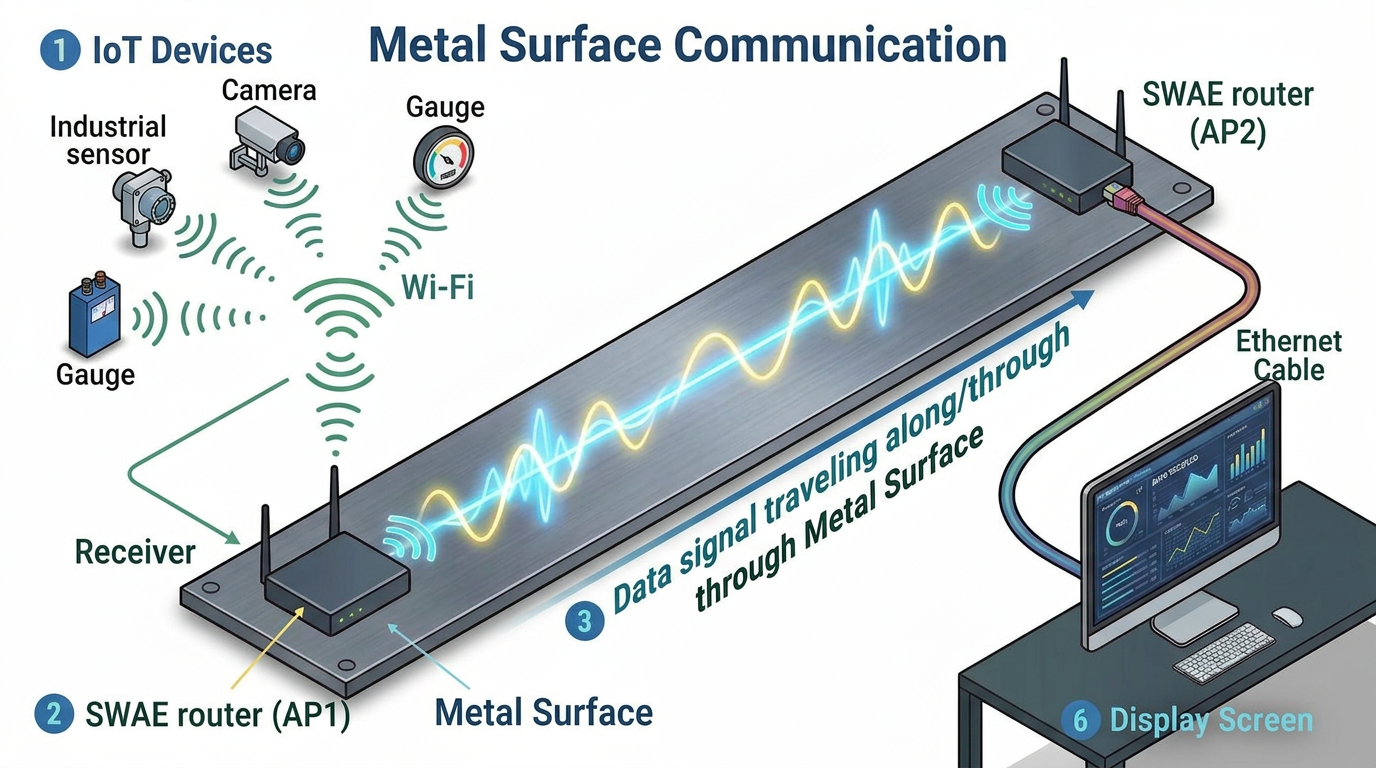
The siganal can be transferred up 600m for one unit (depending on different conditions). It supports WiFi, Bluetooth, ZigBee, LaRo and other protocolls.
Reliable Communication. Safer Tunnel Construction.
In the challenging underground environment, stable communication is essential. Ensure seamless connectivity, real-time coordination, and reliable communication between teams to enhance safety, efficiency, and operational control throughout every stage of tunnel construction.


Precision Drilling. Reliable Performance.
In demanding drilling operations, reliability and control are essential. Ensure seamless communication, real-time monitoring, and dependable connectivity to enhance safety, efficiency, and operational performance throughout every stage of drilling.
Access Point

